

Turning Strategy into Action
Building actionable route-to-market pricing and penetration-led growth plans
Turning Strategy Into Action
Frameworks and insights are valuable only when they translate into clear strategic choices and practical execution plans.
Through UpScalability, I work with leadership teams and their investors to execute a practical approach for translating pricing strategy, penetration-led brand growth insights and route-to-market economics into actionable plans for profitable CPG growth.
The New Dynamic in CPG Markets
Consumer packaged goods categories are entering a period of heightened volatility and competitive intensity.
For lower and middle-market brands, the challenge is particularly acute. Larger competitors increasingly dominate shelf presence, trade spending and marketing investment, while financially constrained consumers are forcing brands to balance pricing decisions with volume and penetration realities.
Even smaller brands within large CPG portfolios are feeling the pressure as capital allocation becomes more disciplined and performance expectations rise.
In this environment, pricing headwinds, slowing velocity and rising costs can quickly expose vulnerabilities in a brand’s profit model.
The key strategic challenge is no longer simply driving growth — it is identifying where profitable growth can actually be created across channels, customers and route-to-market strategies.

The UpScalability Approach
Addressing this challenge requires moving beyond high-level category analysis toward fact-based insights into how brand growth actually translates into contribution margins and operating profit.
The UpScalability approach combines strategic frameworks with data-driven profitability analysis and route-to-market execution planning.
By analyzing pricing dynamics, distribution economics, channel profitability and growth drivers together, leadership teams gain clarity on where to play, how to win and how to allocate resources for profitable growth.
From Strategic Outlooks to Actionable Game Plans
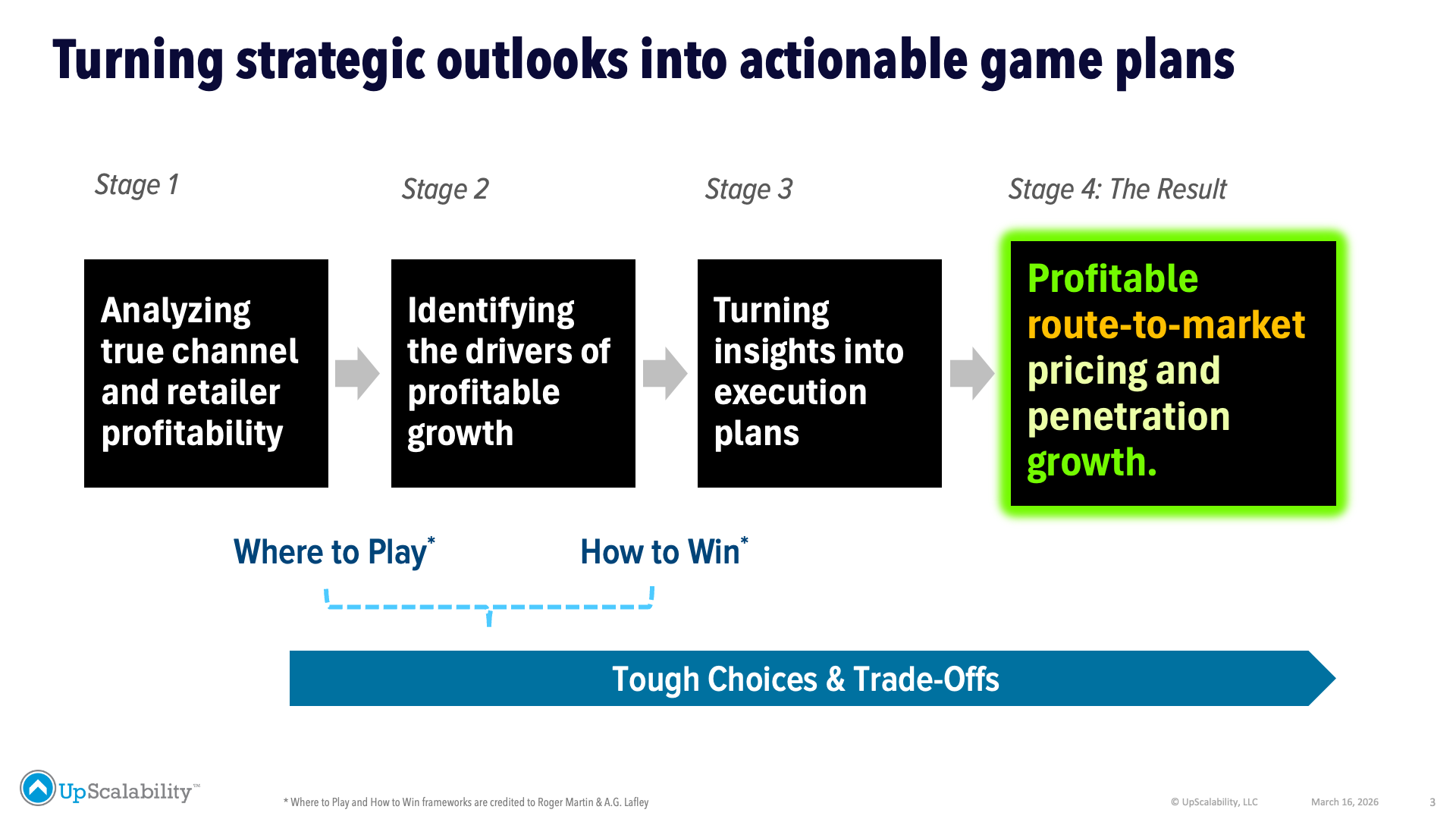
The work typically progresses through four stages.
[1] Analyzing True Channel and Retailer Profitability
The process begins with detailed analysis of marketing and sales contribution margins by route-to-market channel, rather than burying expenses within SG&A.
This reveals where value is truly created or destroyed across customers, channels, brand-packs and geographies.
[12] Identifying the Drivers of Profitable Growth
Using scenario analysis, the financial impact of key growth drivers is evaluated, including:
pricing power
distribution expansion
penetration gains
brand-pack strategy
trade investment and marketing allocation
This stage identifies where meaningful growth opportunities exist.
[3] Turning Insights Into Execution Plans
Strategic insights are then translated into market-specific route-to-market game plans, typically covering a 12–24 month horizon.
These plans outline:
channel expansion priorities
brand-pack opportunities
pricing and trade strategies
retail marketing investments
resource allocation required to deliver results
[4] The Result: Profitable Route-to-Market Pricing and Penetration Growth
Leadership teams gain a clear, financially grounded roadmap for strengthening brand growth and margin performance.
Rather than relying on broad strategic assumptions, decisions are grounded in how pricing, distribution, penetration and investment actually translate into contribution dollars and operating profit.
Hands-on implementation support is provided to execute and anchor operational and behavioral changes.
Acknowledgment
Where to Play and How to Win approaches are credited to Roger Martin & A.G. Lafley
Discuss a Pricing or Growth Strategy Challenge
If your team is evaluating pricing strategy, route-to-market performance or profitable growth opportunities, I would welcome the opportunity to discuss your situation.