

A Penetration-Led Framework for Brand Growth in Any Price Tier.
Pricing Power Is Not Just Premiumization
This article outlines the core thinking behind my perspective on pricing power and brand growth in CPG markets.
It was originally published in earlier writing on pricing power and forms part of the conceptual foundation for the Penetration-Led Brand Growth Flywheel and my forthcoming book, Pricing Power is Brand Power.
Pricing power is widely misunderstood.
It is often equated with premiumization — the ability to charge more than competitors. If a brand commands a higher price, the reasoning goes, it must possess stronger pricing power and therefore stronger brand equity.
That interpretation is incomplete.
Pricing power is not the ability to charge more.
It is a brand’s ability to achieve and sustain strategic, tier-appropriate pricing levels — and to execute necessary price changes over time — in a way that drives long-term, sustainable, profitable brand growth, primarily through household penetration gains.
In simple terms:
Pricing power is penetration-led brand growth — in any price tier.
The Core Misunderstanding: Pricing Power Is Not Premiumization
Across consumer packaged goods (CPG) categories, premiumization is often presented as the primary path to growth. Higher price tiers promise richer margins, lower required unit volumes, and perceived brand elevation.
But categories operate within structured price bands.
Mainstream brands drive scale and broad penetration.
Premium brands extract higher margin per unit.
Value brands anchor affordability and expand access.
Each tier plays a distinct economic role.
The relevant question is not whether premiumization is attractive. The relevant question is whether premiumization alone constitutes pricing power.
It does not.
A premium price point does not automatically confer pricing power. Nor does a mainstream price point preclude it.
Pricing power is defined by how effectively a brand manages price–volume trade-offs within the structural constraints of its category.
Pricing Power Is Tier-Relative and Constrained
There is no infinitely high price level that any brand can sustain to drive perpetual growth.
Pricing power is:
Relative, not absolute
Tier-bound, not unconstrained
Dynamic, not static
Within CPG, pricing power encompasses both:
Price Levels — where a brand sits within a tier relative to competitors
Price Changes — inflationary increases, strategic price holds, temporary price reductions, and promotional intensity
Categories establish prevailing price ranges shaped by:
Competitive alternatives
Shopper price–value perceptions
Availability and distribution
Cost structures
Macro-economic conditions
These factors are interdependent and constantly evolving. The “optimal” price is always in motion.
A brand demonstrates pricing power when it can raise price within its tier without suffering materially worse volume declines than competitors — or when it can hold price strategically to preserve penetration while others escalate.
Sustainability within tier constraints is the test.
Penetration Is the Structural Engine of Brand Growth
Long-term brand growth in CPG is primarily penetration-led.
Brands grow mainly by increasing the number of households that buy them, not by materially increasing purchase frequency among a narrow base of loyalists.
This insight is grounded in decades of evidence-based research conducted by the Ehrenberg-Bass Institute for Marketing Science (EBI) and other marketing scientists studying empirical brand growth patterns across categories and markets.
Penetration has two dimensions:
Horizontal penetration — expanding into new retailers and geographies
Vertical penetration — recruiting new or lapsed households within existing distribution
Distribution is not penetration. Sustainable growth requires both breadth and depth.
Pricing decisions directly influence penetration.
Raise price too aggressively, and penetration erodes. Discount excessively, and contribution compresses, weakening reinvestment capacity.
Sustainable pricing power requires disciplined management of the price–volume equation:
Volume × Price = Sales ; Sales – Costs = Profit
Profit is not the end goal. It is the funding mechanism for sustained brand investment, innovation, and distribution — which in turn strengthen penetration.
Elasticity Is Dynamic and Relational
Pricing power debates often reduce to elasticity metrics.
But elasticity is not fixed.
Price sensitivity varies by:
Geography
Retailer
SKU
Competitive environment
Promotional context
Economic cycle
Elasticity also evolves after a price change, as new and existing households reassess the brand.
Most importantly, elasticity is relational. Shoppers choose from repertoires of brands. A brand’s pricing decision interacts with competitor actions and category norms.
Pricing power cannot be reduced to a single elasticity coefficient. It must be understood as part of a broader economic system.
The Penetration-Led Brand Growth Flywheel
Pricing power emerges from managing an interconnected system — not from occupying a higher price tier.
This system can be described as The Penetration-Led Brand Growth Flywheel.
A brand is Easy to Grow when it is both:
Easy to Buy (from the perspective of shoppers and consumers), and
Easy to Fund (from the perspective of brand owners and investors).
Easy to Buy
A brand is Easy to Buy when it is:
Easy to Think Of (mental availability)
Easy to Find (physical availability)
Easy to Satisfy (functional superiority)
Easy to Justify (credible price–value exchange)
These elements drive penetration and volume.
Easy to Fund
A brand is Easy to Fund when it is:
Easy to Scale (structurally positioned for category and channel growth)
Easy to Monetize (able to generate sufficient contribution margin to reinvest)
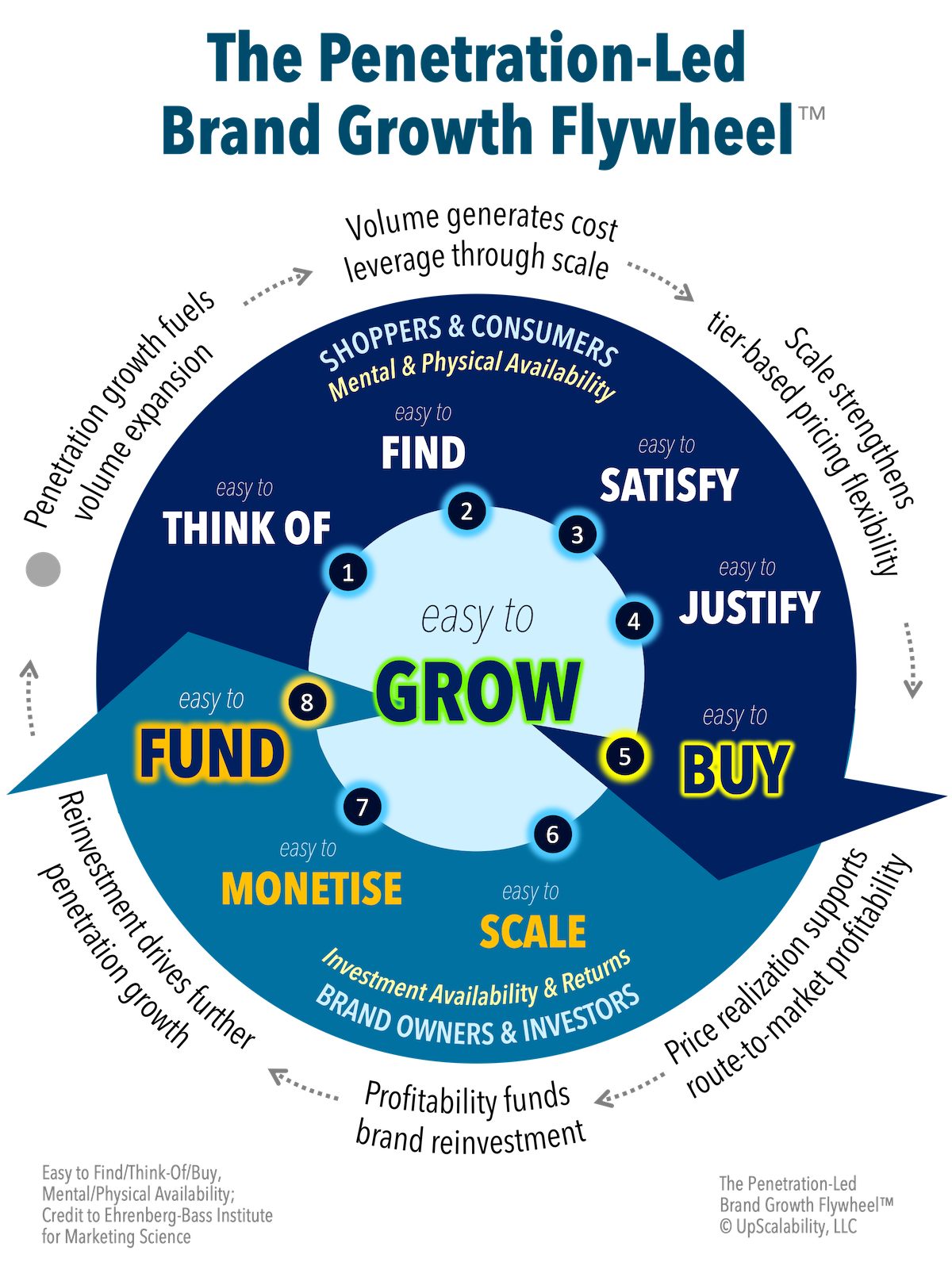
Pricing power is the outcome of an effective flywheel — not a standalone capability.
Mainstream and Premium: Both Can Exhibit Pricing Power
Cost leaders and premium quality-price differentiators represent distinct strategic choices.
Mainstream brands compete on scale and broad penetration. Premium brands compete on perceived quality-price differentiation and, hopefully, higher unit margins.
Neither model guarantees pricing power.
What matters is whether the brand’s pricing strategy is supported by:
Sufficient penetration depth
Manageable elasticity within tier
Disciplined cost structure
Sustained brand investment
Premiumization can enhance profitability. But without sustained penetration and system discipline, it does not constitute pricing power.
The Durable Definition
Pricing power ultimately plays out in moments of choice.
In those moments, shoppers decide whether a brand is easy to think of, easy to find, easy to justify, and easy to satisfy. Over time, those repeated choices determine household penetration.
Penetration drives volume.
Volume strengthens cost leverage.
Cost leverage increases pricing flexibility.
Pricing flexibility influences future penetration.
This is the structural loop that underpins sustainable brand growth.
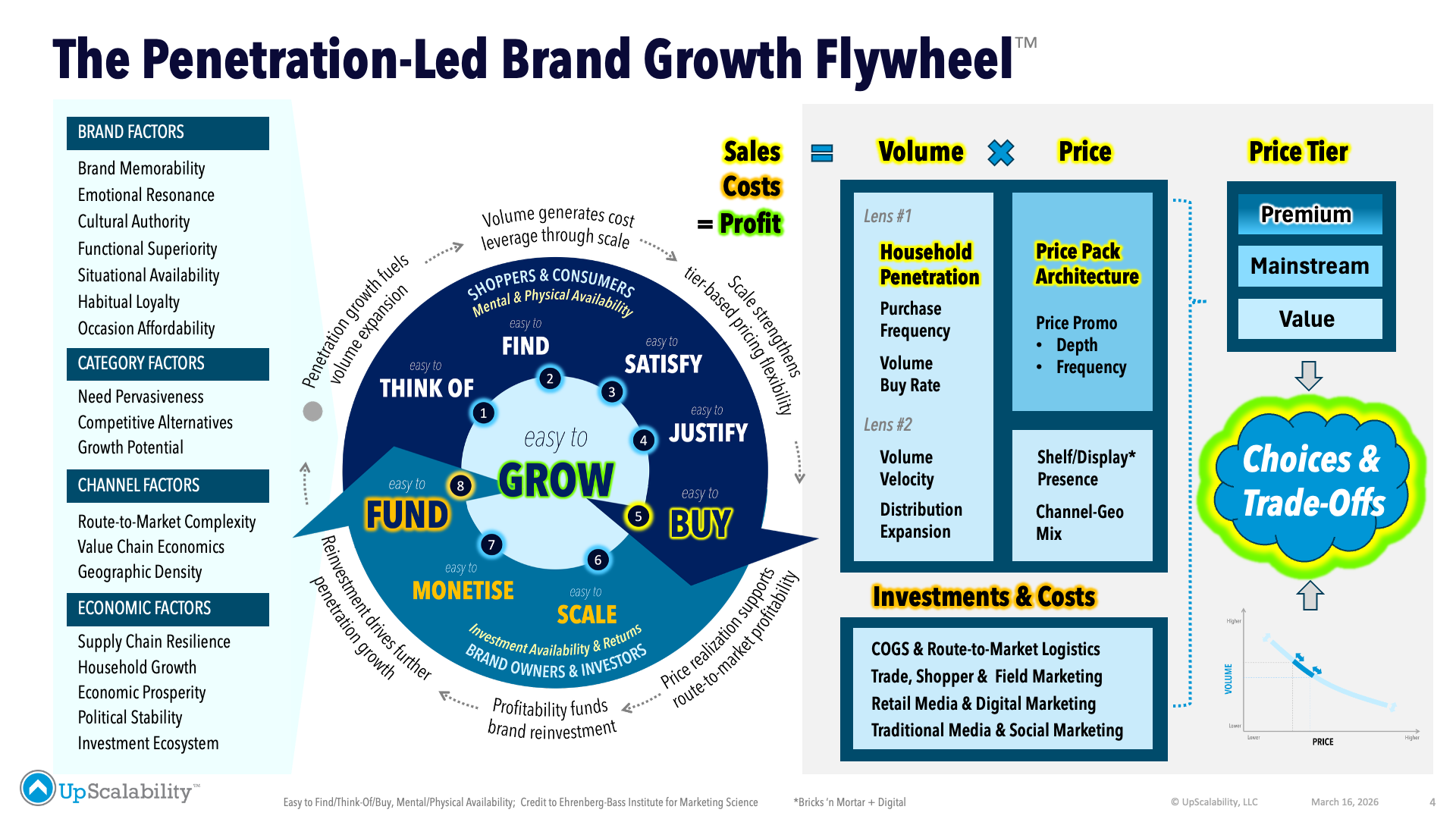
Within that system, pricing is not an isolated lever. It is a strategic choice — exercised within defined price tiers, competitive realities, cost structures, and evolving market conditions.
Therefore:
Pricing power is not the ability to charge more.
It is a brand’s ability to set and sustain strategic, tier-appropriate price levels — and execute necessary price changes — in a way that drives long-term, sustainable, profitable growth primarily through household penetration gains.
Premiumization is a strategy. Mainstream scale is a strategy. Value access is a strategy.
Pricing power is the disciplined management of those choices — within the structural boundaries of a category — to sustain penetration and long-term brand strength.
Acknowledgment
The concepts of Easy to Think Of, Easy to Find, Easy to Buy, Mental Availability, and Physical Availability were developed and popularized by Prof Byron Sharp, and the Ehrenberg-Bass Institute of Marketing Science (EBI) and form a foundational part of evidence-based brand growth theory.
The broader penetration-led view of brand growth reflected here has been influenced by decades of empirical research by EBI, and also includes the work of Prof Koen Pauwels of the D’Amore-McKim School of Business at Northeastern University, and other marketing scientists.
Discuss a Pricing or Growth Strategy Challenge
If you are exploring questions related to pricing strategy, margin performance or growth dynamics in your category, I would welcome the opportunity to discuss your situation.
Much of my advisory work focuses on helping leadership teams apply the principles behind penetration-led brand growth and pricing power to real strategic decisions.