
About Manoli Kulutbanis

Penetration-led brand growth is pricing power.
Four decades of empirical work from the Ehrenberg-Bass Institute — codified in Byron Sharp's How Brands Grow — has established the volume side of this claim unambiguously: brands grow predominantly through penetration (reaching more buyers, building mental and physical availability) rather than through deeper loyalty among existing buyers.
What EBI's work does not always explicitly address is the value side — how pricing, margin, and brand profitability interact with the penetration mechanism. My work extends the empirical tradition into that territory: penetration-led brand growth, properly built, is also what produces enduring pricing power and the structural conditions strategic acquirers pay premium multiples for. Brands that are structurally Easy to Grow are the same brands that are Easy to Buy and Easy to Fund.
Pricing sits at the center of this work — not as a revenue-growth-management tactic, but as the brand-strategic discipline that determines whether a brand can sustain margin while widening penetration. The 4th P of marketing is also the one most often abdicated by marketing teams to finance and sales functions, where its role in building or eroding long-term brand value gets lost. Pricing power is not something a brand charges. It is what a brand earns through sustained penetration-led growth — the discipline that protects margin while the brand widens its consumer base.
I've built two complementary frameworks to address this work, each emerging from a specific question.
I've spent the last fifteen years building the analytical and operational work that connects this empirical extension to the structural decisions CPG brand teams, private equity firms, and strategic acquirers actually face. My background is operating-led — production leadership at Unilever, manufacturing and corporate strategy at SAB Ltd and SABMiller/MillerCoors, operating partner roles in PE-backed portfolio companies — and the work I publish today is the codification of patterns I saw playing out repeatedly across two decades of those engagements.
The Work
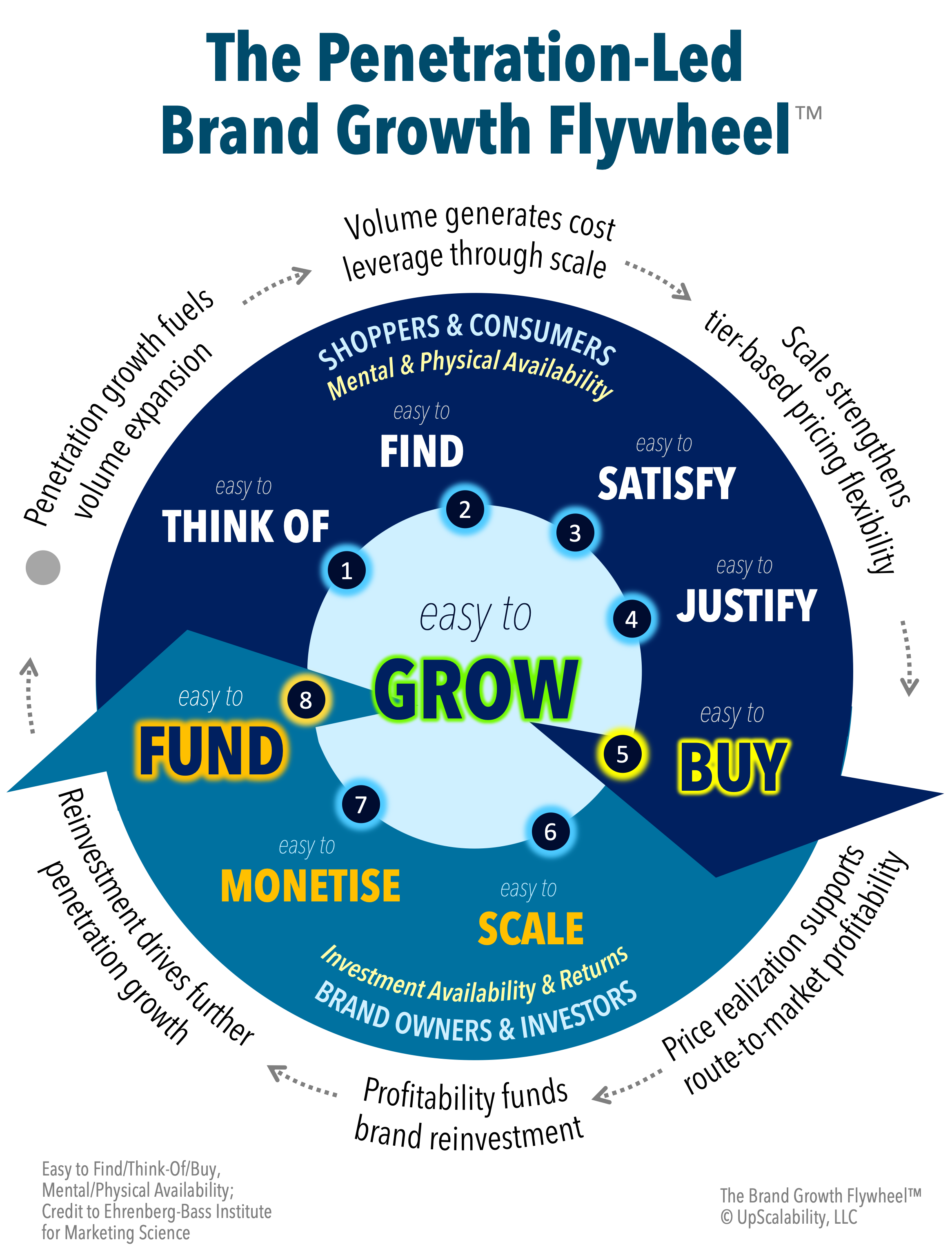
The Penetration-Led Brand Growth Flywheel describes the brand-strategic discipline through which the growth mechanism is built — how penetration, distribution, velocity, pricing, and brand-building reinforce each other over time as a compounding system. It emerged from the operating discipline question: how does a brand build penetration-led growth as a structural posture, not as a campaign?
Margin Velocity Economics (MVE) is the structural diagnostic framework that surfaces whether a brand is genuinely earning the position — or whether surface revenue is masking the conditions that will eventually weaken it. It emerged from the analytical question: how do you tell whether the Flywheel is working before the revenue numbers betray that it isn't? Three diagnostic grids — Unit Economics × Volume, Velocity × Distribution, Loyalty × Penetration — together read whether a brand is structurally building compounding growth.
Background
My operating background spans 25+ years across global CPG and lower-middle-market PE engagements. Production leadership at Unilever South Africa, including the turnaround of Unilever's largest CPG factory in the Southern Hemisphere. Manufacturing development and corporate strategy at South African Breweries Ltd and subsequently SABMiller/MillerCoors, including the Miller Lite revival, the Molson Coors JV business case that produced MillerCoors, and the integration that delivered $765M in combined synergies one year ahead of plan.
Two specific M&A credentials inform how I approach acquirer-side work today. I was a member of the operations and manufacturing due diligence team for South African Breweries' $5.6 billion acquisition of Miller Brewing in July 2002 — buy-side structural diligence on one of the largest cross-border CPG transactions of the period. Earlier, I founded a professional services business sold to Primeserv Group in 2001 as part of one of the most oversubscribed IPOs in Johannesburg Stock Exchange history — first-hand experience on the seller side of a roll-up acquisition, with direct exposure to how buy-side commercial and operational diligence is conducted.
Through UpScalability LLC, the boutique advisory practice I founded in 2010, I have led repeat engagements with a leading global consumer-focused investment firm (2024 route-to-market profitability modeling across 40+ retailers; 2026 commercial diligence on an emerging portfolio brand), an operating partner / interim CEO role at Generation Growth Capital portfolio company Select Food Products, and engagements with multiple national CPG and beverage brands across pricing power, route-to-market design, and commercial intervention.
Engagement
For readers wanting to engage with the thinking before discussing specific work, the canonical MVE paper and the Pricing Power is Penetration-Led Growth Substack carry the body of work in full. Shorter commentary is published through my LinkedIn newsletter, while selected articles are also curated on this site under Insights.
For readers considering a specific engagement — commercial diligence on a CPG target, portfolio commercial intervention, exit-readiness positioning, operating partner / interim executive support — the path forward is a direct conversation.
